
Progressive Overload: Linear vs. Double Progression
Short answer
Progressive overload means gradually increasing training demand so muscles adapt and grow stronger. In practice, add 2 to 10% load once you exceed your target reps on all sets (ACSM 2009), or add repetitions before adding weight (Plotkin 2022). Use linear progression on novice barbell compounds, and double progression on intermediate compounds, dumbbells, and isolation lifts.
What is progressive overload and why does it work?
Progressive overload is the gradual increase of stress placed on muscles and the nervous system across weeks and months so your body has a concrete reason to add strength and muscle tissue. Lifting the same weight for the same reps indefinitely maintains your current baseline, because your body has already adapted to that workload (ACSM 2009).
Two details separate lifters who actually progress from those who spin their wheels:
- Overload follows adaptation, not the other way around. You do not force extra weight onto the bar by shortening your range of motion or swinging your torso. Adding load or reps only counts as real overload when technique, depth, and tempo stay consistent.
- Small, repeatable increments beat big jumps. ACSM (2009) recommends increasing load by 2 to 10% once you can complete 1 to 2 repetitions above your target workload across consecutive sessions. On a 135 lb (60 kg) lift, 2 to 10% is roughly 5 to 10 lb (2.5 to 5 kg)—not a 20 lb jump.
Should you add weight or add reps first?
Both adding weight and adding reps drive muscle growth, so the right choice depends on your goal and the equipment in your hands.
In an 8-week controlled trial directly comparing load progression against repetition progression, Plotkin et al. (2022) found that lifters who kept the weight fixed and added reps achieved muscle hypertrophy comparable to lifters who kept reps fixed and added weight. That backs up what a larger meta-analysis by Schoenfeld et al. (2017) established earlier: high loads (above 60% 1RM) and lower loads (60% 1RM and below) produce similar muscle growth when sets are pushed close to failure, while heavier loads produce clearly superior maximal 1RM strength gains.
That research gives you a practical rule on the gym floor:
- Prioritize adding weight when maximal strength on barbell lifts (barbell squat, barbell bench press, deadlift) is your main goal, or when you can still add 5 lb (2.5 kg) cleanly every week.
- Prioritize adding reps first on dumbbells, cables, machines, and hypertrophy ranges (8–15 reps), where the smallest weight jump on the rack—often 5 lb per dumbbell (10 lb total) or a 10–15 lb cable stack pin—is a 10 to 25% leap that is too steep to make every week.
How do linear progression and double progression compare?
Nearly every effective gym program runs on one of two engines: linear progression or double progression. Knowing which rule belongs on which exercise eliminates guesswork before you unrack the bar.
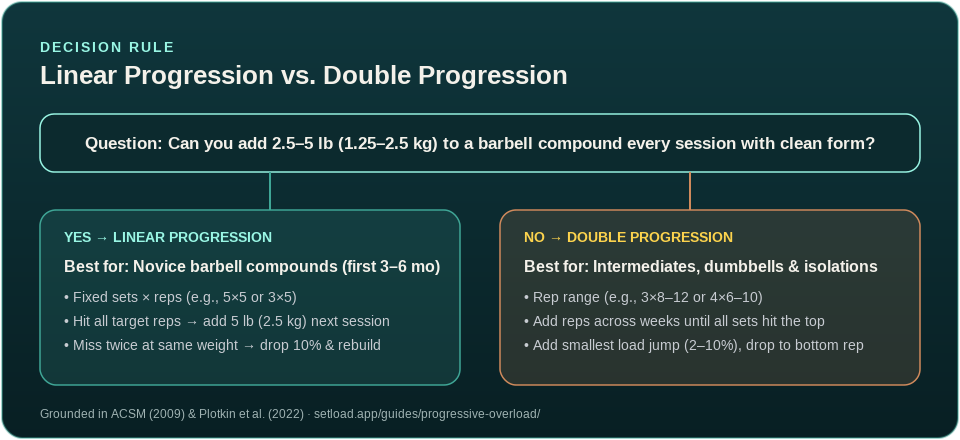
| Factor | Linear Progression | Double Progression |
|---|---|---|
| Structure | Fixed sets × fixed reps (e.g., 5 × 5 or 3 × 5) | Fixed sets × rep range (e.g., 3 × 8–12 or 4 × 6–10) |
| Trigger to add weight | Hit every prescribed rep in one session | Hit the top of the rep range on every set |
| Typical load jump | +5 lb (+2.5 kg) upper / +5–10 lb (+2.5–5 kg) lower | Smallest available jump (2–10%) |
| What happens right after a jump | Keep same rep target (5 × 5) | Reps drop toward bottom of range (e.g., 8–9), then climb back |
| Best exercises | Novice barbell squat, bench, press, row, deadlift | Intermediate compounds, dumbbells, cables, isolations |
| Lifespan before stalling | Typically 8–24 weeks for novices | Indefinite, with periodic deloads |
The decision rule: If you are in your first 3 to 6 months on a barbell compound and still recover cleanly between sessions, use linear progression. The moment a barbell lift stalls twice at the same load—or for any dumbbell, cable, or single-joint exercise from Day 1—switch that lift to double progression.
What does 8 weeks of progressive overload look like with real numbers?
Abstract advice is easy to misunderstand until you see real numbers on a log. Below are two complete 8-week progressions side by side: a novice running linear progression on barbell squat (3 × 5, trained twice weekly; Week 1–8 snapshots) and an intermediate running double progression on incline dumbbell press (3 × 8–12, weight listed per dumbbell).
Example A: Linear Progression — Barbell Squat (3 × 5, once-weekly highlight)
| Week | Load | Sets × Reps Logged | Session Volume | Outcome / Rule Applied |
|---|---|---|---|---|
| Week 1 | 135 lb (60 kg) | 5, 5, 5 | 2,025 lb (900 kg) | Clean → +5 lb (+2.5 kg) |
| Week 2 | 140 lb (62.5 kg) | 5, 5, 5 | 2,100 lb (937.5 kg) | Clean → +5 lb (+2.5 kg) |
| Week 3 | 145 lb (65 kg) | 5, 5, 5 | 2,175 lb (975 kg) | Clean → +5 lb (+2.5 kg) |
| Week 4 | 150 lb (67.5 kg) | 5, 5, 4 | 2,100 lb (945 kg) | Missed 1 rep → hold 150 lb |
| Week 5 | 150 lb (67.5 kg) | 5, 5, 5 | 2,250 lb (1,012.5 kg) | Cleared → +5 lb (+2.5 kg) |
| Week 6 | 155 lb (70 kg) | 5, 5, 5 | 2,325 lb (1,050 kg) | Clean → +5 lb (+2.5 kg) |
| Week 7 | 160 lb (72.5 kg) | 5, 4, 4 | 2,080 lb (942.5 kg) | Missed → hold 160 lb |
| Week 8 | 160 lb (72.5 kg) | 5, 5, 5 | 2,400 lb (1,087.5 kg) | Cleared → +5 lb (+2.5 kg) |
Over 8 weeks, the lifter added 25 lb (12.5 kg) to their 3 × 5 squat (+18.5% load) without a single forced form breakdown, simply by holding the weight on Weeks 4 and 7 until all 15 reps were clean.
Example B: Double Progression — Incline Dumbbell Press (3 × 8–12, weight per dumbbell)
| Week | Dumbbell Weight (Each) | Reps Logged (3 Sets) | Total Reps | Outcome / Rule Applied |
|---|---|---|---|---|
| Week 1 | 45 lb (20 kg) | 10, 9, 8 | 27 reps | Hold 45 lb |
| Week 2 | 45 lb (20 kg) | 11, 10, 9 | 30 reps | +3 total reps → hold 45 lb |
| Week 3 | 45 lb (20 kg) | 12, 11, 10 | 33 reps | +3 total reps → hold 45 lb |
| Week 4 | 45 lb (20 kg) | 12, 12, 12 | 36 reps | All sets hit 12 → jump to 50 lb (22.5 kg) |
| Week 5 | 50 lb (22.5 kg) | 9, 8, 8 | 25 reps | Heavier load (+11%) → hold 50 lb |
| Week 6 | 50 lb (22.5 kg) | 10, 9, 9 | 28 reps | +3 total reps → hold 50 lb |
| Week 7 | 50 lb (22.5 kg) | 11, 10, 9 | 30 reps | +2 total reps → hold 50 lb |
| Week 8 | 50 lb (22.5 kg) | 11, 11, 10 | 32 reps | Keep climbing toward 12, 12, 12 |
Notice why double progression solves the dumbbell-rack problem: jumping from 45 lb to 50 lb dumbbells is an 11.1% increase. You could never make that jump every week, yet earning four extra reps per set first makes the 50 lb jump smooth and repeatable.
If you want a ready-made routine with these progression rules already wired in, both Beginner 5×5 (linear progression) and Full Body 3× (double progression) are free forever in Setload, and you can verify your estimated max climb anytime with our 1RM calculator.
What should you do when progression stalls?
Every lifter eventually hits a wall where neither weight nor reps budge for two to three consecutive sessions. Run through this four-step checklist before rewriting your entire program:
- Check your rest periods first. If you rested 60 to 90 seconds on heavy squats or rows, extending rest to 2.5 to 3 minutes often unlocks 1 to 2 immediate reps on Sets 2 and 3 (see how long to rest between sets).
- Verify your jump size. A 10 lb (5 kg) jump on overhead press or bent-over barbell row can be 8 to 12% of the load. Use 2.5 lb plates (5 lb total) or 1.25 kg plates (2.5 kg total), or check exact plate combos with our barbell plate calculator.
- Check recovery and cumulative fatigue. Poor sleep, high life stress, or 6+ straight weeks of hard pushing can mask strength gains. A 1-week reset (dropping load 10% or cutting sets by 30–50%) often clears fatigue and restarts progress.
- Adjust weekly volume carefully. If you are recovering well, sleeping enough, and still stuck after a reset, check whether the muscle is under-dosed (fewer than 8–10 weekly sets) or over-dosed (above 18–20 sets) using our weekly sets guide.
What are the most common progressive overload mistakes?
- Trading range of motion for weight. Cutting squat depth by two inches or bouncing the barbell off your chest adds fake weight while reducing mechanical tension on the target muscle. Keep your standards identical every week.
- Not writing down last session’s numbers. Guessing whether you did 8 or 9 reps two weeks ago turns progression into memory lottery. Log weight and reps every session.
- Changing exercises every two weeks. Your nervous system takes 2 to 4 weeks to coordinate a new lift cleanly. Keep core compounds in place for at least 8 to 12 weeks so you can measure true progress on the same movements.
- Ignoring sharp pain. Muscle effort and mild soreness are normal; sharp joint pain is a stop signal. If something hurts, stop and ask a qualified professional.
Questions people ask
How fast should you add weight to the bar?
Novices on barbell compounds can often add 5 lb (2.5 kg) on upper-body lifts and 5 to 10 lb (2.5 to 5 kg) on lower-body lifts every one to two weeks during their first few months. Intermediates typically add 2.5 to 5 lb (1.25 to 2.5 kg) every 3 to 6 weeks via double progression—which still adds 20 to 40 lb to a lift over a year.
Does adding one rep really count as progressive overload?
Yes. Moving from 155 lb × 8, 8, 8 (24 reps) to 155 lb × 9, 8, 8 (25 reps) increases total volume and mechanical stimulus at the same load. Plotkin et al. (2022) confirmed that progressing reps produces muscle growth on par with progressing load directly.
Can you apply progressive overload without heavier weights at home?
Yes. When you max out your dumbbells, you can increase reps up to 20–25 per set (Schoenfeld 2017 showed lower loads still build hypertrophy near failure), add a 1-second pause at the stretched bottom position, slow the lowering phase to 3 seconds, or switch to unilateral variations such as Bulgarian split squats or single-leg Romanian deadlifts.
Do you need to beat last week’s log every single workout?
No. Strength fluctuates day to day with sleep, hydration, and stress. Judge progressive overload over a 3-to-4-week trend rather than panicking over a single flat Tuesday session.
Sources
- Progression Models in Resistance Training for Healthy Adults. Medicine & Science in Sports & Exercise, 41(3):687-708. https://doi.org/10.1249/MSS.0b013e3181915670
- Progressive overload without progressing load? The effects of load or repetition progression on muscular adaptations. PeerJ, 10:e14142. https://doi.org/10.7717/peerj.14142
- Strength and Hypertrophy Adaptations Between Low- vs. High-Load Resistance Training: A Systematic Review and Meta-analysis. Journal of Strength and Conditioning Research, 31(12):3508-3523. https://doi.org/10.1519/JSC.0000000000002200