
How Many Sets Per Week to Build Muscle?
Short answer
Most lifters build muscle fastest with 10 to 20 hard working sets per muscle group per week, split across at least two sessions. Beginners grow well on 6 to 10 weekly sets per muscle, while intermediates typically thrive between 10 and 16 sets. Meta-analyses show 10+ weekly sets outperform fewer than 5 sets (Schoenfeld 2017; Baz-Valle 2022).
What does the science say about weekly sets and muscle growth?
Weekly set volume—counted as hard working sets per muscle group per week—is one of the clearest levers for muscle growth. In a landmark meta-analysis of 15 resistance-training studies, Schoenfeld, Ogborn, and Krieger (2017) found a graded dose-response relationship between weekly sets and hypertrophy: training 10 or more weekly sets per muscle produced significantly greater growth (averaging +9.8% across included studies) than fewer than 5 sets (+5.4%).
A subsequent systematic review by Baz-Valle et al. (2022) focused specifically on trained lifters and concluded that 12 to 20 weekly sets per muscle group represents a practical, evidence-backed standard range for maximizing hypertrophy. Pushing above 20 sets can work briefly for a single lagging muscle, yet rarely pays off across the whole body because systemic fatigue and joint irritation climb faster than new muscle growth.
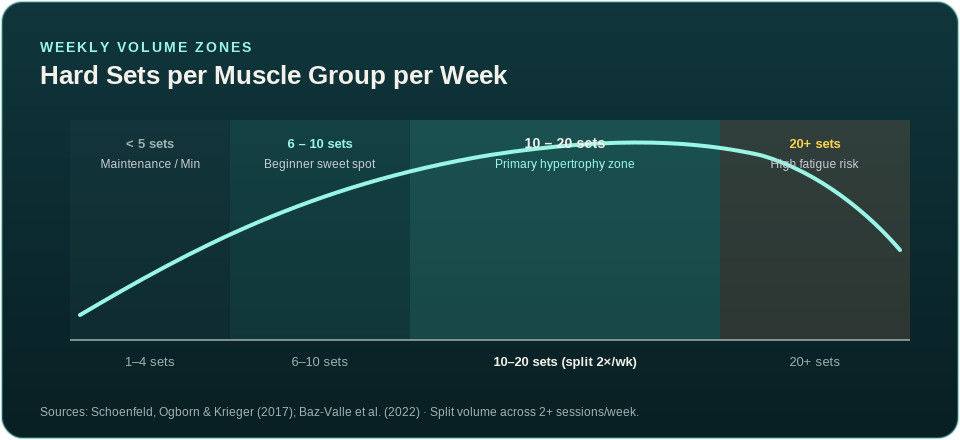
Distribution matters just as much as the weekly total. Schoenfeld et al. (2019) showed that when total weekly volume is equated, frequency has little independent effect—yet splitting 12 to 16 weekly sets across 2 or 3 sessions keeps fatigue manageable so sets 9 through 16 remain high quality instead of exhausted junk volume.
How many weekly sets does each muscle group need?
Different muscles recover at different speeds and receive different amounts of indirect work during heavy compounds. Beginners need far fewer sets because every session is a novel stimulus (ACSM 2009), while intermediates and advanced lifters need higher volume to keep nudging adaptation forward.
Use this table as a starting budget of direct weekly working sets (before adding indirect compound overlap):
| Muscle Group | Beginner (0–1 yr) | Intermediate (1–3 yr) | Advanced (3+ yr) | Primary Compound Overlap |
|---|---|---|---|---|
| Chest | 6 – 10 | 10 – 16 | 14 – 20 | Minimal (primary mover) |
| Back (Lats + Upper Back) | 8 – 10 | 12 – 18 | 16 – 22 | Indirect from deadlifts/RDLs |
| Quads | 6 – 10 | 10 – 16 | 14 – 18 | Minimal (primary mover) |
| Hamstrings | 4 – 8 | 8 – 12 | 12 – 16 | Secondary on squats/hip thrusts |
| Glutes | 4 – 8 | 8 – 14 | 12 – 18 | Heavy indirect from squats & hinges |
| Side & Rear Delts | 4 – 8 | 8 – 14 | 12 – 18 | Rear delts assisted by rows |
| Front Delts | 0 – 4 | 4 – 8 | 6 – 10 | Heavy indirect from all chest presses |
| Biceps | 4 – 6 | 8 – 12 | 10 – 16 | Heavy indirect from rows & pulldowns |
| Triceps | 4 – 6 | 8 – 12 | 10 – 14 | Heavy indirect from bench & overhead press |
| Calves & Abs | 4 – 8 | 8 – 14 | 12 – 16 | Minimal direct overlap |
Notice how front delts, biceps, and triceps sit lower on direct sets than back or quads: if you already perform 12 sets of pressing and 14 sets of rowing and pulldowns per week, your arms and front shoulders are already doing substantial work before you pick up a single dumbbell curl.
What counts as a working set—and how do you count indirect sets?
Not every set logged in a notebook stimulates muscle growth. Two simple rules keep your weekly count honest:
- Count only hard working sets. A working set means roughly 6 to 20 reps taken close to muscular failure—typically leaving 0 to 3 reps in reserve (where the final reps slow down noticeably despite strong effort). Warm-up sets (empty bar, 40%, 60%, 80% ramps) never count toward your weekly total.
- Use the 1.0 / 0.5 fractional rule for multi-joint lifts. Many coaches count a compound exercise as 1.0 set for its primary mover and 0.5 sets for its main synergists (Baz-Valle 2022 highlights why accounting for secondary muscle involvement matters when comparing biceps and triceps volume).
Here is how the 1.0 / 0.5 rule works on four staple lifts:
- Barbell Bench Press (4 sets) = 4.0 chest, 2.0 triceps, 2.0 front delts.
- Bent-Over Barbell Row (4 sets) = 4.0 upper back/lats, 2.0 biceps, 2.0 rear delts.
- Wide-Grip Lat Pulldown (3 sets) = 3.0 lats, 1.5 biceps.
- Barbell Squat (4 sets) = 4.0 quads, 2.0 glutes.
How do you audit your current routine’s weekly volume?
Let’s audit a real intermediate 4-day Upper / Lower split (matching our Upper / Lower 4× program, included in Setload Pro) so you can see how the arithmetic works before changing anything in your own plan.
Suppose your week includes:
- Upper A: Bench Press 4×6–10 (165 lb / 75 kg), Barbell Row 4×6–10 (155 lb / 70 kg), Seated DB Press 3×8–12, Wide-Grip Lat Pulldown 3×10–15, DB Bicep Curl 3×10–15, Rope Triceps Pushdown 3×10–15.
- Upper B: Barbell Shoulder Press 4×6–10, Pull-Ups 4×5–10, Incline DB Press 3×8–12, Seated Cable Row 3×10–15, Side Lateral Raise 3×12–20, Hammer Curl 3×10–15.
- Lower A & B: Squat 4×5–8, Front Squat 3×8–12, Leg Press 3×10–15, Leg Extension 3×12–20, RDL 3×8–12, Deadlift 3×3–6, Lying Leg Curl 3×10–15, Hip Thrust 3×8–12, Standing Calf Raise 8 total sets.
Here is the audited weekly set tally using the 1.0 / 0.5 fractional method:
| Muscle Group | Direct Sets (1.0) | Indirect Sets (0.5) | Effective Weekly Total | Assessment (Intermediate) |
|---|---|---|---|---|
| Chest | 7 (Bench 4 + Incline 3) | 0 | 7.0 sets | Low-normal; room to add 3 sets (e.g., flyes or dips) if chest lags |
| Back (Lats + Upper) | 14 (Rows 7 + Pulldown/Pull-Up 7) | 1.5 (Deadlift 3 × 0.5) | 15.5 sets | Squarely in the 12–18 set sweet spot |
| Quads | 13 (Squat 4 + Front 3 + Press 3 + Ext 3) | 0 | 13.0 sets | Ideal 10–16 set range |
| Hamstrings | 6 (RDL 3 + Leg Curl 3) | 1.5 (Deadlift 3 × 0.5) | 7.5 sets | Solid; can add 2–3 seated leg curl sets if desired |
| Biceps | 6 (Curls 3 + Hammer 3) | 7.0 (14 back sets × 0.5) | 13.0 sets | Right in target range |
| Triceps | 3 (Pushdown 3) | 7.0 (14 pressing sets × 0.5) | 10.0 sets | Adequate; add 2–3 overhead extension sets if arms are a priority |
Look at what that 3-minute audit reveals: instead of blindly adding 10 sets everywhere, you immediately see that Back (15.5) and Quads (13.0) are already dialed in, while Chest (7.0) and Triceps (10.0) are the only areas with headroom to grow if progress slows. Setload tracks weekly muscle-group set volume automatically in Pro (and charts your last 90 days free), and beginners can start with balanced lower volume using our free Full Body 3× plan.
When should you add or cut weekly sets?
Never change weekly sets just because you read a higher number online. Adjust volume by 2 sets per muscle per week only when your log confirms one of these triggers:
- Add 2 sets if a muscle recovers well ahead of the next session, soreness is minimal or gone within 24 hours, and your weight and reps on that muscle have stayed flat for 3+ weeks despite good sleep and progressive overload effort.
- Keep sets unchanged if your weights or reps are climbing every 1 to 3 weeks. If you are progressing on 10 weekly sets, adding 6 more sets only buys fatigue.
- Cut 2 to 4 sets if strength drops across two straight sessions, target muscles still feel beaten up when the next workout arrives, or joint aches accumulate. If something hurts, stop and ask a qualified professional.
What are the most common volume mistakes?
- Cramming all 15 sets into one “bro split” day. By set 10 of chest in a single session, central and local fatigue drops your load and rep output dramatically. Splitting those 15 sets across two sessions—as in Push Pull Legs or Upper/Lower—yields far higher set quality.
- Counting easy warm-ups or half-hearted sets. Doing 20 sets at 5+ reps short of failure produces less growth than 10 focused sets taken within 1–2 reps of failure.
- Raising volume for every muscle at once. Your systemic recovery is a shared pie. If you push chest and arms up to 16 sets during a specialization block, hold quads and back near maintenance (6–8 sets) for those 6 to 8 weeks.
- Copying pro bodybuilder volumes as a beginner. Jumping straight to 20 sets per muscle in Month 1 causes severe soreness, poor technique, and missed workouts—when 6 to 10 crisp sets would have built faster gains.
Questions people ask
Can you build muscle with only 6 sets per week?
Yes, especially as a beginner or during a busy life stretch. Schoenfeld et al. (2017) found clear muscle growth even at 5 to 9 weekly sets (+6.6% mean increase across studies), though moving up to 10+ sets produced larger gains for trained lifters.
What is the maximum number of sets per muscle in a single workout?
Many coaches cap direct working sets for one muscle at roughly 6 to 10 sets per session. Beyond about 10 hard sets in one sitting, performance drop-off makes additional sets far less productive than moving them to a second training day later in the week.
How many exercises per muscle group does 10–16 weekly sets take?
At 3 to 4 working sets per exercise, 10 to 16 weekly sets equals just 3 to 4 exercises spread across two workouts—for example, 4 sets of bench press and 3 sets of incline dumbbell press on Day 1, plus 3 sets of dumbbell bench press and 3 sets of flyes on Day 2 (13 total sets).
Should weekly set counts change when cutting weight or short on sleep?
During lower-calorie phases or high-stress weeks, recovery capacity narrows. Holding intensity (weight on the bar) steady while trimming weekly volume by 20–30% helps preserve strength and muscle without digging a recovery hole. You can track whether your estimated max holds steady using our 1RM calculator.
Sources
- Dose-response relationship between weekly resistance training volume and increases in muscle mass: A systematic review and meta-analysis. Journal of Sports Sciences, 35(11):1073-1082. https://doi.org/10.1080/02640414.2016.1210197
- A Systematic Review of the Effects of Different Resistance Training Volumes on Muscle Hypertrophy. Journal of Human Kinetics, 81:199-210. https://doi.org/10.2478/hukin-2022-0017
- How many times per week should a muscle be trained to maximize muscle hypertrophy? A systematic review and meta-analysis of studies examining the effects of resistance training frequency. Journal of Sports Sciences, 37(11):1286-1295. https://doi.org/10.1080/02640414.2018.1555906
- Progression Models in Resistance Training for Healthy Adults. Medicine & Science in Sports & Exercise, 41(3):687-708. https://doi.org/10.1249/MSS.0b013e3181915670