
RPE and RIR Explained: Chart, %1RM & Guide
Short answer
RPE (Rate of Perceived Exertion) rates how hard a lifting set felt from 1 to 10, while RIR (Reps in Reserve) counts how many clean reps you had left before failure. They are exact inverses: RPE 8 equals 2 RIR, RPE 9 equals 1 RIR, and RPE 10 equals 0 RIR (Zourdos 2016). Most productive working sets sit at RPE 7 to 9 (1 to 3 RIR).
What is the difference between RPE and RIR?
Both RPE and RIR measure the exact same thing—how close a set came to muscular failure—from opposite directions. In modern strength training, RPE + RIR = 10.
- RIR (Reps in Reserve) counts how many additional clean repetitions you could have completed with proper form before failing. Stopping with 2 reps left in the tank is 2 RIR.
- RPE (Rate of Perceived Exertion) converts that reserve onto a 1-to-10 effort scale anchored specifically to resistance training (Zourdos 2016), rather than the older 6-to-20 Borg cardio scale.
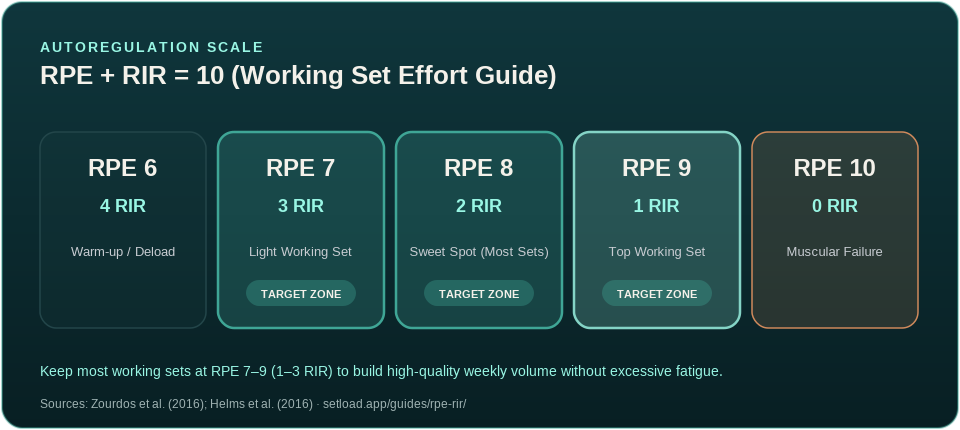
Here is how each rating feels under the bar:
| RPE | RIR | What the Final Rep Feels Like | Typical Training Role |
|---|---|---|---|
| 10 | 0 RIR | Absolute limit; zero clean reps left | Max test or final isolation set |
| 9.5 | 0.5 RIR | Could not do another rep, might add 2.5–5 lb | Heavy peaking single |
| 9 | 1 RIR | Bar speed slowed hard; 1 clean rep left | Top heavy set or final compound set |
| 8.5 | 1.5 RIR | Definitely 1 rep left, maybe 2 | Top hypertrophy set |
| 8 | 2 RIR | Challenging, bar slowed slightly, 2 clean reps left | Primary sweet spot for compounds |
| 7.5 | 2.5 RIR | Definitely 2 reps left, maybe 3 | Moderate working volume |
| 7 | 3 RIR | Crisp bar speed, 3 clean reps left | Early volume sets or technique work |
| 6 | 4 RIR | Fast bar speed, 4+ reps left | Last warm-up set or light recovery week |
Most hypertrophy and strength volume belongs between RPE 7 and RPE 9 (1 to 3 RIR) (Helms 2016). Stopping at RPE 5 leaves growth stimulus on the table, while grinding every compound set to RPE 10 spikes systemic fatigue and degrades later sets.
How do RPE and RIR convert to % of 1RM?
Because RPE tells you how many total reps you could have performed to failure (total_reps = reps_done + RIR), you can tie RPE directly to estimated percentage of one-rep max using the Epley equation (%1RM = 1 / (1 + (reps + RIR) / 30) for effective maxes above 1 rep; Epley 1985).
Using the same Epley math as our 1RM calculator, here is the consistent RPE ↔ RIR ↔ %1RM lookup chart:
| RPE (RIR) | 1 Rep | 3 Reps | 5 Reps | 8 Reps | 10 Reps |
|---|---|---|---|---|---|
| 10 (0 RIR) | 100% | 91% | 86% | 79% | 75% |
| 9 (1 RIR) | 94% | 88% | 83% | 77% | 73% |
| 8 (2 RIR) | 91% | 86% | 81% | 75% | 71% |
| 7 (3 RIR) | 88% | 83% | 79% | 73% | 70% |
| 6 (4 RIR) | 86% | 81% | 77% | 71% | 68% |
Read the chart like a grid: 5 reps at RPE 8 (2 RIR) behaves like a 7-rep maximum, which lands at roughly 81% of your 1RM. 8 reps at RPE 8 (2 RIR) behaves like a 10-rep maximum, landing near 75% of your 1RM. Individual leverage and fiber makeup shift these numbers by 2 to 4% either way, so treat the table as a starting estimate and refine it with your own training log.
How do you pick a weight and adjust sets using RPE?
Fixed percentage programs assume you have the exact same strength every Tuesday. Real life does not work that way: poor sleep, travel, or heavy work stress can shift your day-to-day strength by 5 to 10% (Helms 2016). RPE lets you autoregulate—keeping the training stimulus right on target regardless of the day.
Let’s walk through a real example on the barbell squat for a lifter with a 300 lb (136 kg) 1RM whose program prescribes 1 top set of 5 reps at RPE 8, followed by 3 back-off sets of 5 reps at −8% load.
Scenario 1: Normal Rested Day
- From the table above, 5 reps at RPE 8 sits near 81% 1RM:
300 × 0.81 = 243 lb, rounded to 245 lb (110 kg). - Warm-ups (45 lb, 135 lb, 185 lb, 220 lb) move fast. You hit 245 lb × 5 with 2 clean reps left—right on RPE 8.
- Back-off sets (−8%):
245 × 0.92 = 225 lb (102.5 kg)for 3 × 5. You finish all working sets crisp and strong.
Scenario 2: Tired Day (5 Hours of Sleep)
- During your final warm-up at 220 lb (100 kg) × 3, the bar feels noticeably heavier than usual.
- Instead of stubbornly loading 245 lb and grinding an ugly RPE 9.5, you drop your top set to 235 lb (107.5 kg) × 5. It feels like a solid RPE 8 (2 RIR).
- Back-off sets (−8% of today’s top set):
235 × 0.92 = 215 lb (97.5 kg)for 3 × 5.
You hit the exact intended physiological stimulus without wrecking your lower back or turning a normal week into an unplanned max-out. You can calculate bar loading for either weight in seconds with our barbell plate calculator.
Should beginners use RPE or stick to fixed reps?
Novices should learn RIR as a habit of observation first, not as the main rule that picks their weights. Zourdos et al. (2016) tested novice and experienced squatters and found that experienced lifters rated RIR-based RPE significantly more accurately—especially on moderate-to-high loads—while beginners frequently underestimated how many reps they still had left.
Many coaches bridge that gap with a 3-week calibration protocol:
- Week 1: Follow your normal fixed rep range (for example, 3 × 8–10 on barbell bench press or Romanian deadlift) and simply write down your RIR guess after every set. Do not adjust weights yet.
- Week 2: On the final set of one safe exercise (such as dumbbell bench press, lat pulldown, or side lateral raise), predict when you have 2 reps left—then safely push to technical failure (stopping the moment form breaks) to see whether “2 RIR” was actually 2 reps or 5 reps.
- Week 3: Use that feedback to calibrate your compound ratings. Most beginners discover their early “RPE 9” was really an RPE 7, which immediately sharpens effort across every workout.
How do you log RPE without slowing down your workout?
Logging RPE takes two seconds when you treat it as a single number next to each working set—never a paragraph. Record only working sets (skip warm-ups), and pick either whole numbers (7, 8, 9) or half steps (8.5) once you have six months of practice.
In Setload on iPhone, every set row supports optional RPE right alongside weight and reps, so you can see whether last week’s 225 lb × 5 was an easy RPE 7 or a grinder RPE 9.5 before deciding to add weight in your progressive overload cycle.
What are the most common RPE and RIR mistakes?
- Rating cardio breathlessness instead of muscle failure. After 10 reps of heavy barbell squats, your lungs burn even when your legs still have 3 clean reps left. Base RIR strictly on whether your muscles could move the weight again with good form, not how hard you are breathing.
- Using RPE on 20-rep burn sets. Accuracy drops steeply above 12–15 reps because discomfort feels like failure early. RIR works best in the 1-to-12 rep zone (Zourdos 2016).
- Letting RPE become an excuse to sandbag. Autoregulation works in both directions: on days you feel great and warm-ups fly up, RPE 8 means adding 5 to 10 lb (2.5 to 5 kg) over last week, not only cutting weight on tired days.
- Pushing technical breakdown to hit RPE 10 on barbell lifts. Rounding your back on a barbell deadlift is already past technical failure. Stop when form breaks; if something hurts, stop and ask a qualified professional.
Questions people ask
Should I use RPE or RIR?
They measure the same effort (RPE = 10 − RIR), so pick whichever feels clearer in your head. Many lifters prefer RIR for 6-to-15-rep hypertrophy sets (“how many more reps could I do?”) and RPE for heavy 1-to-5-rep strength work where half-steps like RPE 8.5 or 9.5 help describe bar speed.
What RPE is best for building muscle?
Most hypertrophy working sets sit at RPE 7 to 9 (1 to 3 RIR). That puts you close enough to failure to recruit high-threshold muscle fibers while keeping fatigue low enough to complete your target weekly sets per muscle cleanly.
How does RPE interact with rest periods?
If you cut rest too short between sets, the exact same weight climbs from RPE 7 on Set 1 to RPE 10 on Set 3 simply because local energy has not recovered. Keep rest steady at 2 to 3 minutes on compounds so RPE changes reflect real fatigue rather than rushed pacing (see how long to rest between sets).
Do I need to track RPE on every single exercise?
No. Tracking RPE on your primary compound lifts (squat, bench, deadlift, overhead press, rows) gives you 80% of the benefit with almost zero friction. On small isolations like lateral raises or curls, simply working inside a clean double-progression rep range near 1–2 RIR is plenty.
Sources
- Novel Resistance Training-Specific Rating of Perceived Exertion Scale Measuring Repetitions in Reserve. Journal of Strength and Conditioning Research, 30(1):267-275. https://doi.org/10.1519/JSC.0000000000001049
- Application of the Repetitions in Reserve-Based Rating of Perceived Exertion Scale for Resistance Training. Strength & Conditioning Journal, 38(4):42-49. https://doi.org/10.1519/SSC.0000000000000218
- Poundage Chart. Boyd Epley Workout, Lincoln, NE (chart).