
Deload Week: When to Take One & 3 Methods
Short answer
A deload week is a planned 5-to-7-day reduction in training stress—typically cutting working sets by 30 to 50% and/or lowering load by 10 to 20% while stopping further from failure (Bell 2023). Most intermediate lifters benefit from a deload every 4 to 8 weeks, or reactively when strength dips across two straight sessions. One light week clears fatigue without losing muscle or strength.
What is a deload week and why does it work?
A deload week is a deliberate, structured 5-to-7-day reduction in training stress designed to clear accumulated physiological and mental fatigue, restore readiness, and set up the next block of progressive overload (Bell 2023). It is not a lazy week off, and it is not a sign that your routine failed.
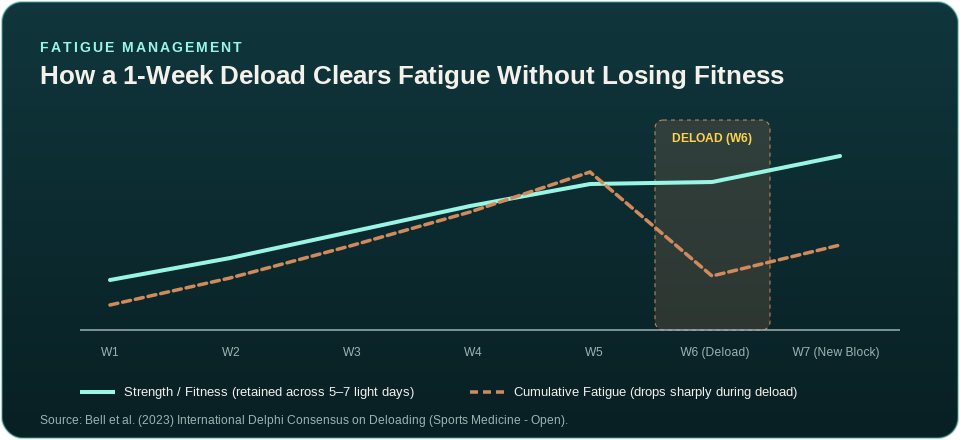
Every hard training block builds two things at the same time: fitness (strength and muscle) and fatigue (central nervous system wear, connective-tissue irritation, local soreness). Fitness decays slowly over weeks, whereas fatigue drops rapidly within 5 to 7 days of lighter training. Cutting volume and effort for one week wipes away fatigue while keeping your lifting mechanics and strength intact—which is why many lifters hit personal records two weeks after a deload.
How do you know when you need a deload week?
In an international Delphi consensus of strength and physique coaches and researchers, Bell et al. (2023) noted two valid scheduling approaches: proactive deloads planned every 4 to 8 weeks (commonly every 6 weeks for hard intermediate blocks), and reactive (autoregulated) deloads triggered when fatigue signals pile up.
Run this 6-point When-to-Deload Checklist at the end of any hard training week. If 3 or more statements are true, schedule a deload for next week:
- Performance drop: Your reps or working weights fell on two or more core lifts across two consecutive sessions despite normal effort.
- Rising RPE at the same weight: Warm-ups and normal working sets that usually feel like RPE 7.5–8 suddenly feel like RPE 9–9.5 (see our RPE and RIR guide).
- Nagging joint or tendon stiffness: Elbows, knees, shoulders, or lower back feel persistently stiff during warm-ups longer than usual. (Sharp or worsening pain needs medical attention, not just a deload—if something hurts, stop and ask a qualified professional.)
- Lingering muscle soreness: Target muscles are still noticeably sore when the same session returns 3 to 4 days later.
- Sleep or motivation dip: You dread walking into the gym for a full week, or sleep quality has worsened alongside high life stress.
- 6+ consecutive hard weeks logged: You have pushed close to failure (1–2 RIR) for six or more straight weeks without a lighter week.
Complete beginners in their first 2 to 3 months rarely need scheduled deloads because absolute loads are still light and recovery is rapid. Intermediates lifting heavier multi-joint loads benefit noticeably once weekly volume climbs past 12 sets per muscle (see how many sets per week to build muscle).
What are the 3 best ways to run a deload week?
Bell et al. (2023) found that reducing training volume (working sets) and stopping further from failure (lower RPE / higher RIR) are the primary levers for clearing fatigue without losing movement skill. Pick one of these three clean methods for 5 to 7 days:
| Deload Method | Exact Adjustment | RPE Target | Best Fit |
|---|---|---|---|
| 1. Volume Cut (Keep Weight) | Cut working sets by 50%; keep normal working weight (or −5%) and normal reps | RPE 6–7 (3–4 RIR) | Strength-focused lifters who want barbell feel to stay sharp |
| 2. Load + Volume Cut (Classic) | Cut working sets by 30–50% AND reduce bar weight by 15–20% | RPE 5–6 (4+ RIR) | High joint/connective-tissue fatigue after a heavy 6–8 week block |
| 3. Frequency Cut (Half-Week) | Cut training days in half (e.g., 4 days → 2 full-body light sessions) at −10% load | RPE 6–7 (3–4 RIR) | Busy travel/work weeks when mental burnout is high |
One strict rule across all three methods: never reduce the weight and then add extra reps to “get a burn.” Turning 4 × 6 @ 185 lb into 4 × 15 @ 135 lb creates huge metabolic and muscular fatigue and defeats the entire purpose of the deload.
What does a deload week look like with real numbers?
Take a standard intermediate training week on two anchor lifts: barbell squat (4 × 6 @ 225 lb / 100 kg) and barbell bench press (4 × 8 @ 175 lb / 80 kg). Here is how all three methods transform that exact week:
| Lift | Normal Week (RPE 8–8.5) | Method 1: Volume Cut | Method 2: Load + Volume Cut | Method 3: Frequency Cut |
|---|---|---|---|---|
| Barbell Squat | 4 × 6 @ 225 lb (100 kg) · 5,400 lb | 2 × 5 @ 225 lb (100 kg) · 2,250 lb (−58%) | 2 × 6 @ 185 lb (82.5 kg) · 2,220 lb (−59%) | 2 × 5 @ 205 lb (90 kg) once that week · 2,050 lb (−62%) |
| Barbell Bench Press | 4 × 8 @ 175 lb (80 kg) · 5,600 lb | 2 × 6 @ 175 lb (80 kg) · 2,100 lb (−63%) | 2 × 8 @ 145 lb (65 kg) · 2,320 lb (−59%) | 2 × 6 @ 155 lb (70 kg) once that week · 1,860 lb (−67%) |
| Barbell Row / Deadlift | 4 × 8 @ 155 lb / 3 × 5 @ 275 lb | Cut sets in half; stop 3–4 reps short of failure | Cut sets in half and drop weight 15–20% | Combine into 2 short 35-min sessions |
Every method drops total weekly tonnage by roughly 55 to 65% while keeping the exact same exercises in your hands so neuromuscular coordination never gets rusty. Use our barbell plate calculator to load the lighter deload percentages quickly without mental math.
Should you take a deload week or a complete week off?
Most lifters stay sharper on an active deload week than a total week off, because touching light barbells preserves technique and prevents the heavy return-to-lifting soreness that follows seven full days away from the gym.
Take a complete 5-to-7-day rest week only when:
- You are traveling with zero gym access;
- You are recovering from illness or severe sleep deprivation; or
- Mental burnout is high enough that stepping away from the gym floor completely sounds like a relief.
How to return in Week 1 after a deload: Do not immediately max out on Monday. Start your new block slightly below your previous peak—around 90 to 95% of your pre-deload working weights (or RPE 7–7.5, Helms 2016)—and ramp back past your old numbers in Weeks 2 and 3. Tracking per-exercise history charts and weekly volume in Setload makes two-week fatigue dips easy to spot before a stall sets in—for example, when running Upper / Lower 4× or Squat, Bench, Deadlift 3× (both included in Setload Pro).
What are the most common deload mistakes?
- Turning a deload into a novelty week. Trying brand-new exercises during a deload triggers unfamiliar muscle soreness (DOMS), adding fatigue instead of clearing it. Keep the exact same lifts (barbell deadlift, bent-over barbell row, squat, bench) at lighter volume.
- Testing 1RMs because you feel fresh by Thursday. Feeling springy halfway through a deload means it is working—do not cash out that recovery early with an unplanned max attempt.
- Slashing calories or protein during the deload. Your tissues are actively repairing during a light week; keep food and sleep steady at maintenance.
- Forgetting to tag the deload in your log. If you look back at a light
145 lb × 8week without a note, it can look like a sudden strength crash. Add a brief"Deload"note to the session.
Questions people ask
Will I lose muscle or strength during a 1-week deload?
No. Muscle loss and meaningful detraining take multiple weeks of complete inactivity. A 5-to-7-day deload with reduced volume retains both muscle mass and strength while clearing fatigue so you come back stronger (Bell 2023; ACSM 2009).
How often should you schedule a deload week?
Most intermediates deload every 4 to 8 weeks depending on training volume, sleep, and outside stress (Bell 2023). High-volume 6-day splits typically need a deload closer to every 4 to 6 weeks, while moderate 3-day full-body programs can often go 8+ weeks between deloads.
Should you skip cardio during a deload week?
Easy low-intensity walking or light cycling is completely fine and often helps recovery. Simply skip hard sprints or grueling conditioning circuits during a deload so systemic fatigue stays low.
What if I feel weaker on my first workout back after a deload?
That is normal for one session—heavy loads can feel momentarily unfamiliar after a light week. Stick to RPE 7–7.5 on Day 1 back, and bar speed usually snaps right back by your second or third workout. You can check estimated max trends anytime with our 1RM calculator.
Sources
- Integrating Deloading into Strength and Physique Sports Training Programmes: An International Delphi Consensus Approach. Sports Medicine - Open, 9:87. https://doi.org/10.1186/s40798-023-00633-0
- Progression Models in Resistance Training for Healthy Adults. Medicine & Science in Sports & Exercise, 41(3):687-708. https://doi.org/10.1249/MSS.0b013e3181915670
- Application of the Repetitions in Reserve-Based Rating of Perceived Exertion Scale for Resistance Training. Strength & Conditioning Journal, 38(4):42-49. https://doi.org/10.1519/SSC.0000000000000218